Sustainability report co-editing module

The report is not a document compiled at the end, but a cross-departmental and AI collaboration that needs to be managed.

A sustainability report involves multiple departments, numerous disclosure requirements, and repeated content revisions and reviews. Without a consistent collaboration process, the project team can easily fall into a situation of continuous reminders, confusing versions, missing specifications, and unclear sign-off progress.

The sustainability report co-editing module centrally manages chapter division, content writing, disclosure standard inspection, supporting information and sign-off process, so that each content has a person in charge, every modification is recorded, and every audit result can be traced, helping the team to steadily advance the report preparation work.

Common management pain points in enterprises

It is difficult to collect cross-department information on time

Different chapters of the sustainability report are usually responsible for different departments, and windows, deadlines and progress are managed decentrally. The organizer needs to send letters and reminders repeatedly, but it is still difficult to grasp the overall completion status in real time.

The file version is confusing and the modified content is difficult to track.

After files are transferred back and forth by multiple people, problems such as duplicate versions, overwritten content, or misuse of old versions are likely to occur. It is also difficult to confirm who modified what content at what time.

There are many disclosure standards, and it is easy to miss items or the verification is incomplete.

Each chapter may correspond to multiple sustainability standards and disclosure requirements at the same time. Manual verification one by one is not only time-consuming, but also may result in missing important items due to scattered information.

The sign-off progress is not transparent and the reason for return is difficult to trace.

The content of the report needs to be reviewed by multiple levels of supervisors, but which level the document is currently sent to, who handles it, and the reason for return are often scattered in emails and messages, increasing communication and confirmation costs.

The supporting information is scattered and must be sorted out before verification.

Attachments and supporting files are often scattered on personal computers, mailboxes or shared folders. When it comes to internal audit or external verification, the team searches, categorizes and confirms again, which lengthens the preparation time.

How does the module connect the report preparation process?

The module organizes the report preparation process into eight steps:

  1. Create Report

    Add, copy or import existing Word reports to quickly create a report structure for the current year.

  2. Set chapters and permissions

    Set chapters, responsible personnel, editing permissions and sign-off methods according to organizational needs.

  3. Division of work

    Each department collaborates to edit the content according to the chapters it is responsible for, and the module synchronously presents the overall completion progress.

  4. Standard check

    Compare various disclosure guidelines and standard requirements to confirm whether the content is complete item by item.

  5. Send for signature and review

    Send the content to the supervisor for review according to the set process to ensure that the report is confirmed by the appropriate level.

  6. Revision Confirmation

    Return the modification based on the approval comments and retain the process so that each adjustment has a record to follow.

  7. File Compilation

    Centrally manage supporting materials and attachments, and establish the relationship between chapter content and supporting documents.

  8. Report Output

    Compile the completed and approved content, output the complete report, and connect with subsequent publishing operations.

Core functions

Centralized management of annual reports

Centrally manage various reports on an annual basis, support adding and copying existing reports, assist project teams in quickly establishing a reporting structure, and monitor the editing status of each report. > Picture location: below the description of this function; corresponding to the module operation screen on page 11 of the briefing.
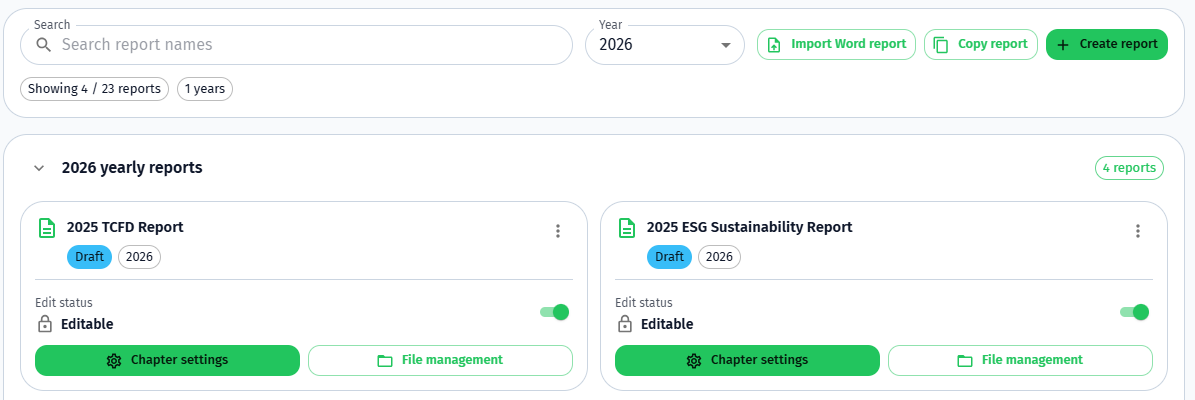
Annual report management screen of the sustainability report co-editing module

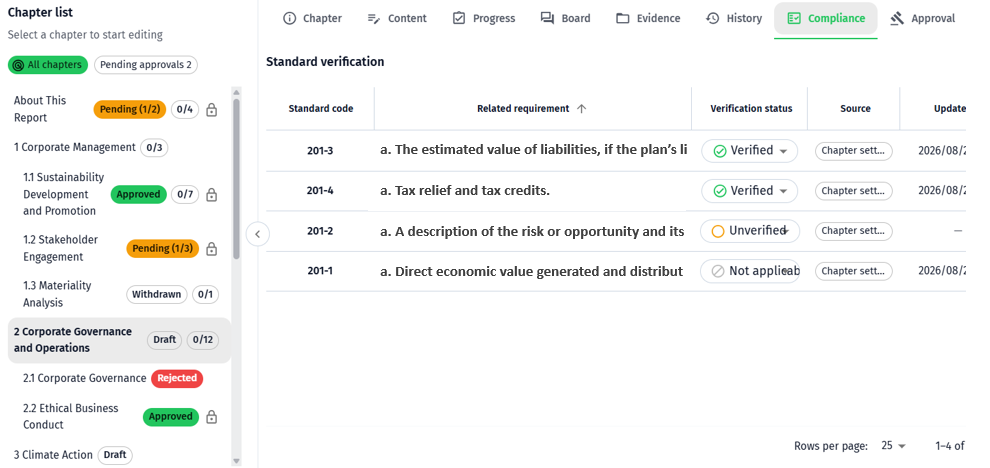
Chapter permissions and approval process settings

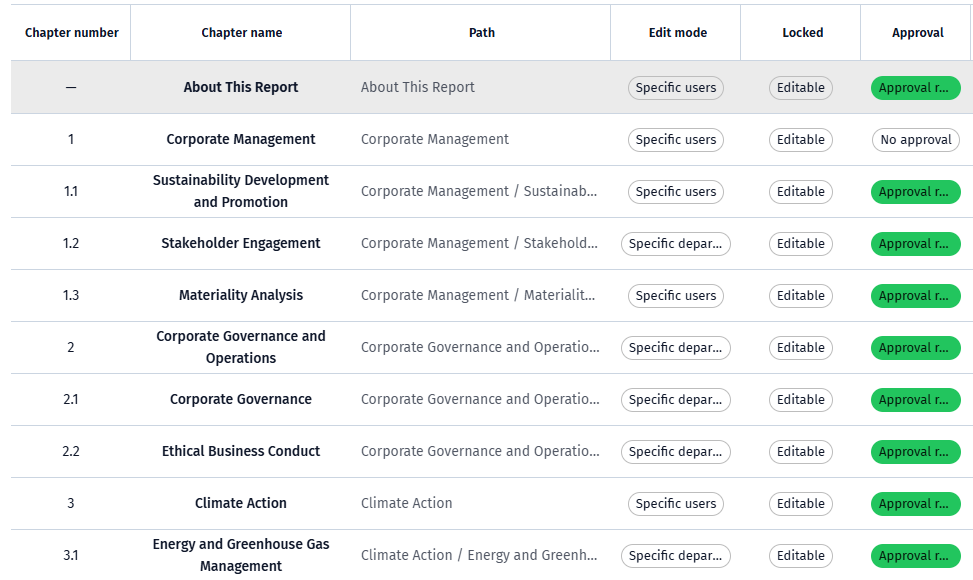
The editing permissions, locking status and approval process of each chapter can be flexibly set to ensure that the content is collaborated by appropriate personnel and reviewed in accordance with the company's internal procedures. > Picture location: below the description of this function; corresponding to the module operation screen on page 12 of the briefing.

Chapter permissions and approval setting screen of the sustainability report co-editing module

Disclosure Standard Check

Centrally manage the regulatory requirements and inspection status corresponding to each chapter, allowing users to clearly understand the progress of compliance and reducing the risk of missing items or incomplete content. > Picture location: below the description of this function; corresponding to the module operation screen on page 13 of the briefing.

Disclosure standard verification screen of the sustainability report co-editing module

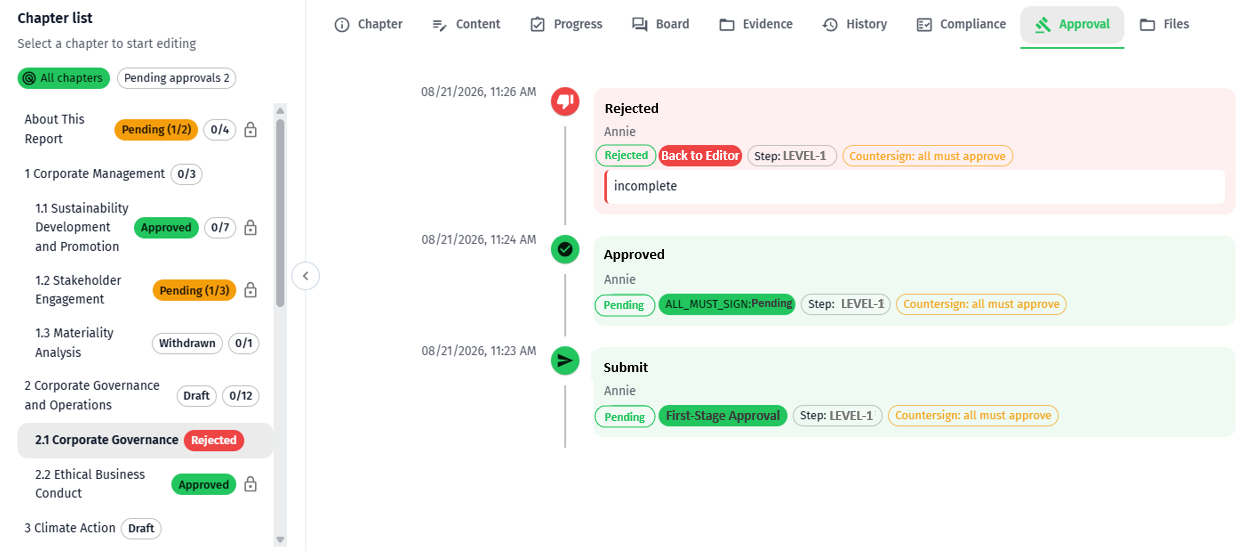
Signing and return process

Completely record the process of report submission, approval and return, and clearly display each approval level, processing opinions and time, so that the entire review progress can be traced. > Picture location: below the description of this function; corresponding to the module operation screen on page 14 of the briefing.

Signature process screen of the sustainability report co-editing module

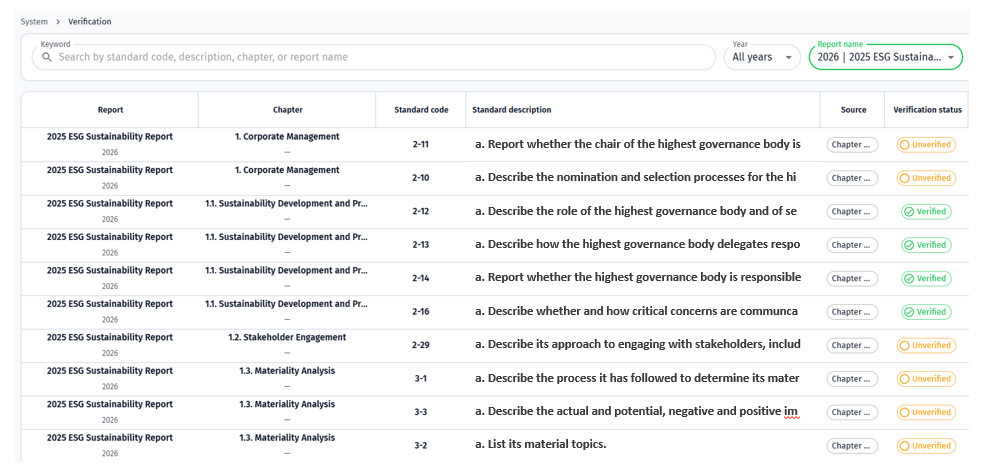
Overall follow status control

It compiles the regulatory requirements and inspection status of each chapter to help managers quickly grasp the overall compliance status and information that still needs to be supplemented. > Picture location: below the description of this function; corresponding to the module operation screen on page 15 of the briefing.

Standard compliance overview screen of the sustainability report co-editing module

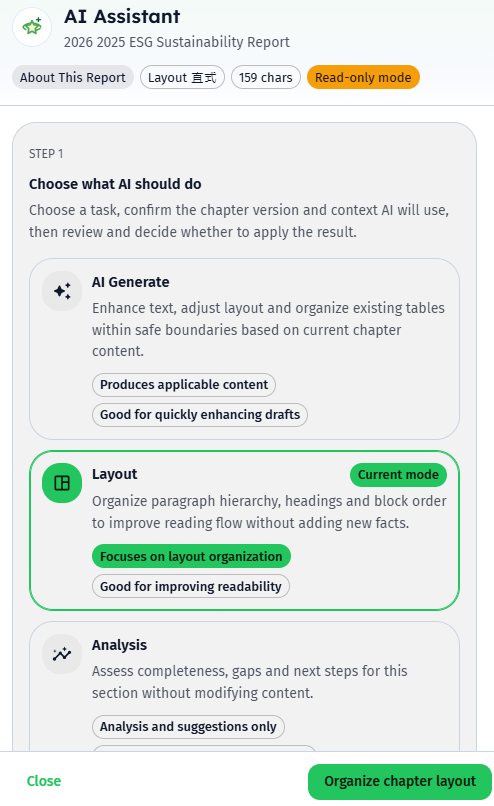
AI assistant assisted content organization

Through the AI assistant to assist in chapter analysis, content enhancement and layout adjustment, users can review suggestions before deciding to adopt them, improving report writing efficiency while retaining manual review and editing rights.

AI assistant screen of sustainability report co-editing module

What changes can be brought about after importing?

Cross-department collaboration: from urging items one by one to monitoring progress in real time

Organizers no longer need to confirm repeatedly through emails, messages and forms. They can directly check the person in charge, editing status and completion progress of each chapter to quickly find out the items to be processed.

File management: from scattered versions to single platform collaboration

Centralized editing of report content and retention of the revision process can reduce the risk of misuse of old versions, overwriting of content, and duplication of arrangements.

Standardized inspection: from manual item-by-item checking to item-by-item tracking

Disclosure specifications can directly correspond to report chapters, and the status of checked and unchecked is clearly displayed, making it easier for the team to grasp the gaps.

Sign-off process: from asking around to becoming transparent and traceable

Each submission, approval, return and modification are fully retained, so you can clearly understand the current level, processing opinions and to-do items.

Verification preparation: from temporary file search to daily continuous accumulation

Attachments can be centrally managed according to reports and chapters. Corresponding documents can be quickly found during internal audits or external verifications, shortening preparation time.

Management control: from scattered information to clear global progress

Managers can monitor the report progress, standard inspection status and sign-off results from the unified interface, and detect delays and gaps early.

Turn sustainability goals into the next actionable step

Talk to us