
Centralized management of sustainable questionnaires
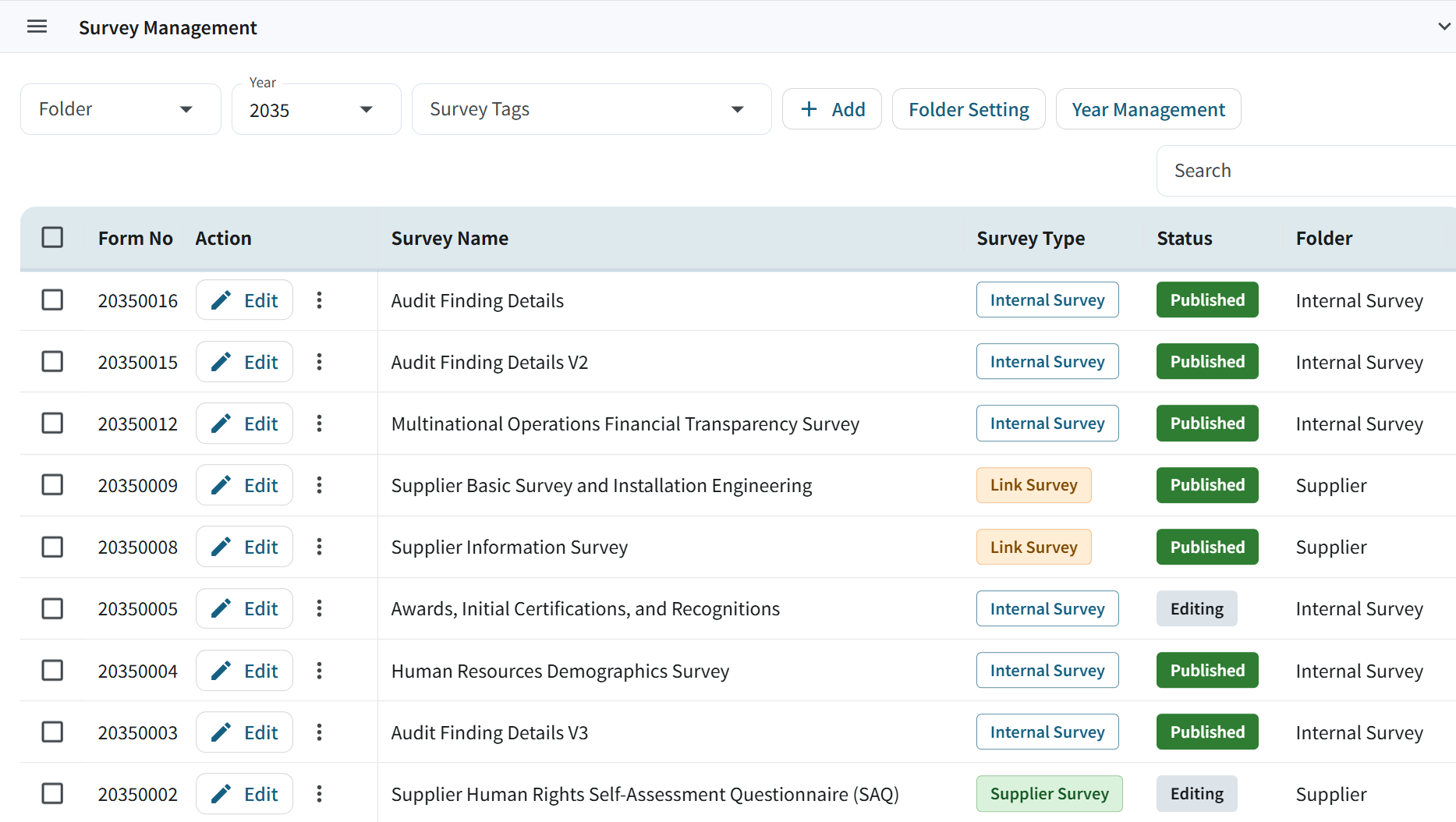
Centrally manage internal, supplier and linked questionnaires, flexibly set the survey period and release status, and quickly grasp the progress of various sustainable data collection.
Integrate sustainability data inside and outside the company into visible sustainability performance
Sustainable performance is not about filling out a questionnaire, but a management process of continuous collection, review, comparison and improvement. The system can integrate the sustainability information of the company's internal departments and external suppliers based on the indicators required by specifications or initiatives such as GRI, IFRS S1/S2, TCFD/TNFD, CDP, etc., centrally manage the response content, supporting attachments and approval records, and convert the results into statistical charts, risk levels and reporting information, allowing managers to continuously understand sustainability performance and issues for improvement.
Environmental, social and governance information is scattered among different departments. Investigation windows, submission deadlines and response progress are mostly tracked by email or Excel, making it difficult to grasp missing items in a timely manner.
Different suppliers may have different questions, survey periods, and attachment requirements; the organizer must send, collect, and confirm one by one, and it is easy to miss those who have not yet responded.
Internal surveys, supplier evaluations, and project questionnaires each use different forms, making it difficult to consolidate the results and establish consistent scores and risk determination standards.
Questionnaire answers, supporting documents and review comments are scattered in mailboxes and folders, making it difficult to confirm whether the information has been approved and who completed the review when.
After collecting the questionnaires, the organizer has to reorganize the statistical data, create charts and write summaries, and then copy them to the sustainability report, which increases transcription errors and repeated work.
From questionnaire design, object release to statistical analysis and report application, the system completely connects the collection, review and disclosure process of sustainable performance data, so that every answer has a source, every result has evidence, and annual performance can be continuously tracked.
Survey theme setting → Questionnaire design → Object and period setting → Questionnaire release and filling → Collection of responses and attachments → Scoring and risk determination → Sign-off and review → Statistical analysis and report connection
Establish internal surveys, supplier evaluations or project-based sustainability questionnaires according to annual and management needs.
Flexibly create single-choice, multiple-choice, numerical and text question types, and set required conditions, attachment requirements and scoring rules.
Designate internal personnel, departments or suppliers to fill in the answers, and set the investigation start and end time and folder classification.
Publish the survey through the system or questionnaire link, and centrally manage the filling in and progress of different objects.
Automatically organize answer content and supporting files, and you can view and export data according to questionnaires, questions or details.
Calculate the total score of the questionnaire and the risk level according to the set rules, and quickly identify high-risk suppliers or projects that need to be improved.
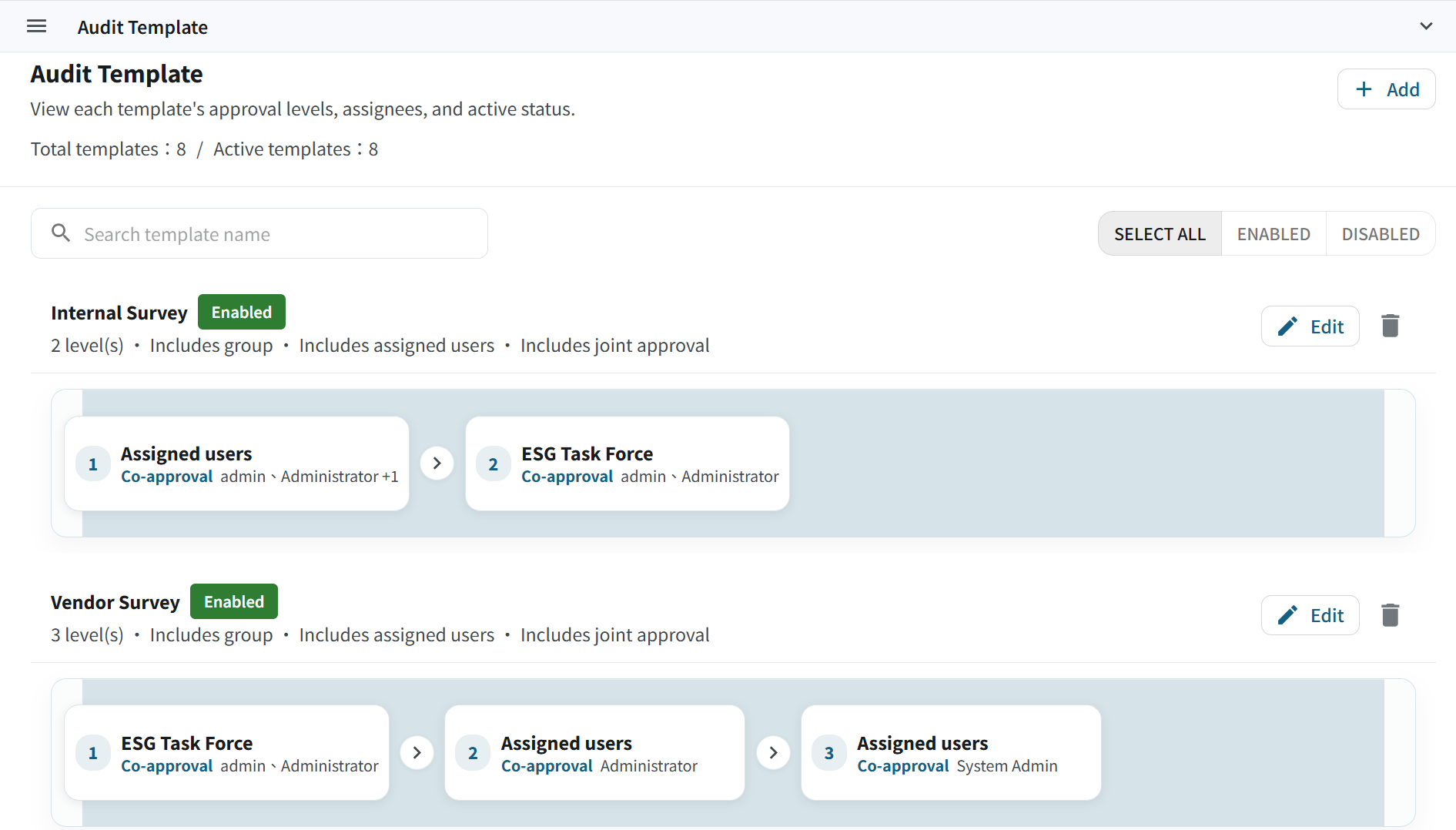
Apply a multi-level approval template according to the questionnaire type, and designate individuals or groups to complete the data review and approval.
Convert responses into charts and summary text, and directly bring them into the sustainability report co-editing module to connect information disclosure.
Centrally manage internal, supplier and linked questionnaires, flexibly set the survey period and release status, and quickly grasp the progress of various sustainable data collection.
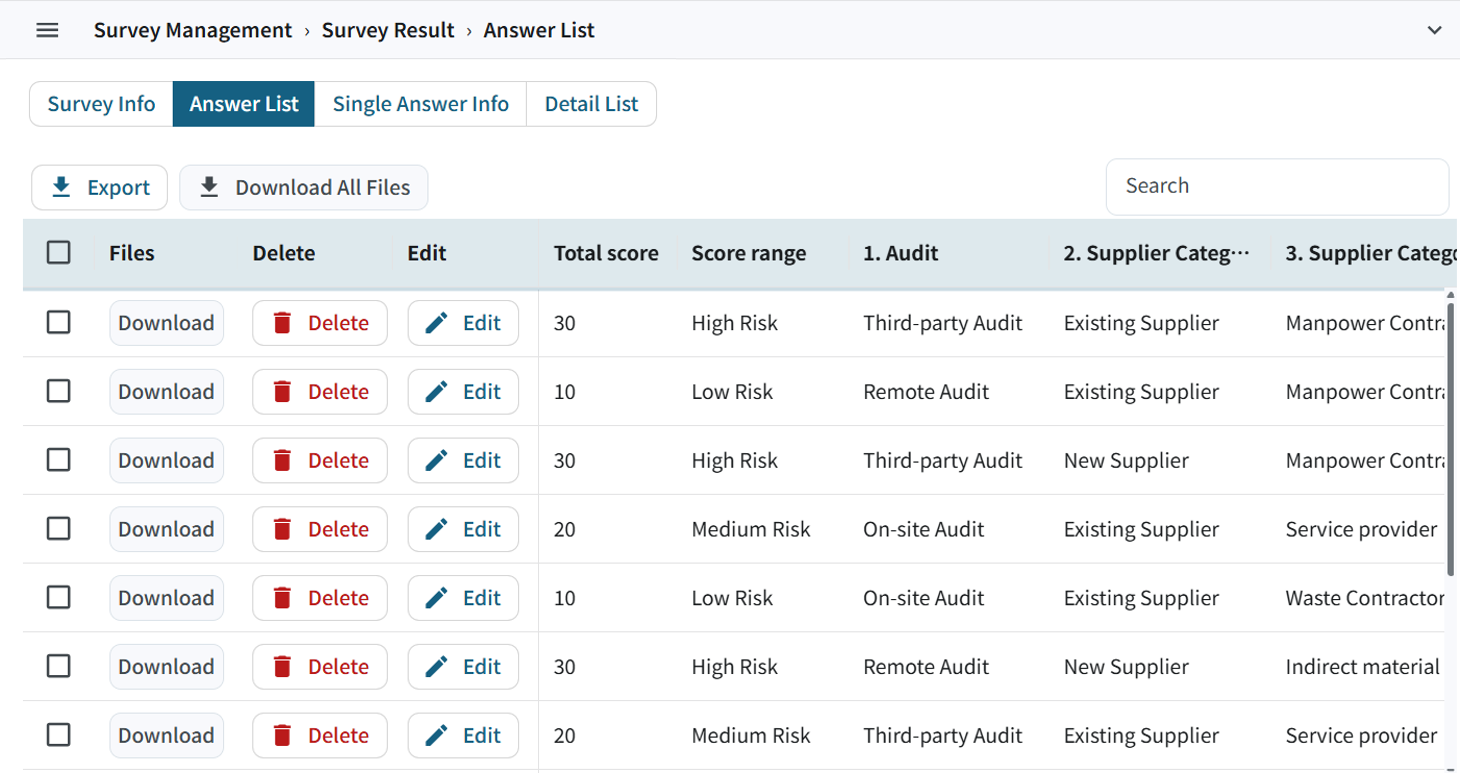
Automatically compile questionnaire answers and attachments, calculate scores and risk levels according to set rules, and quickly identify high-risk suppliers and follow-up audit needs.
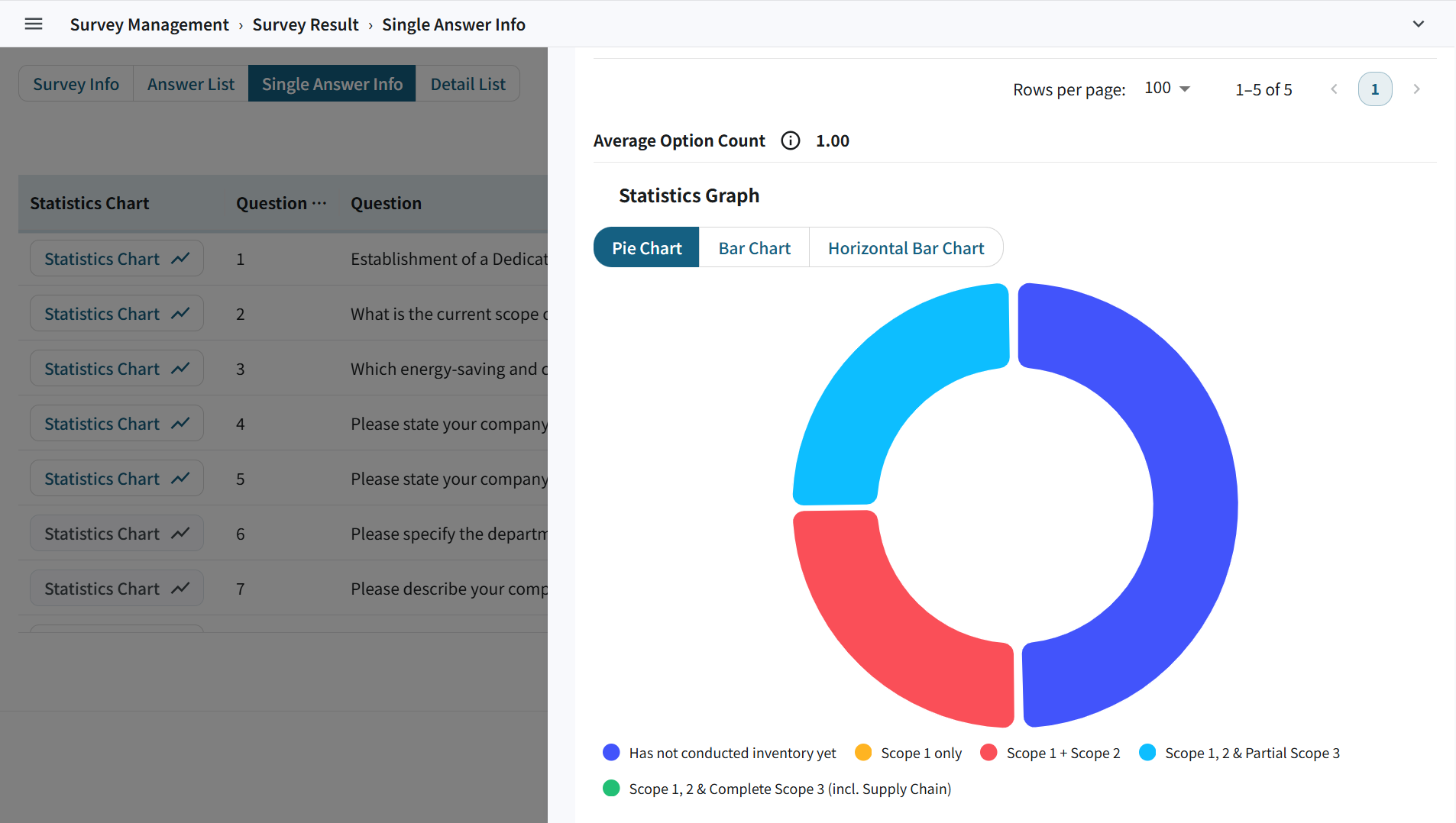
Instantly convert questionnaire responses into visual statistics such as pie charts and bar charts to quickly understand the distribution of answers to each question and the overall sustainable performance status.
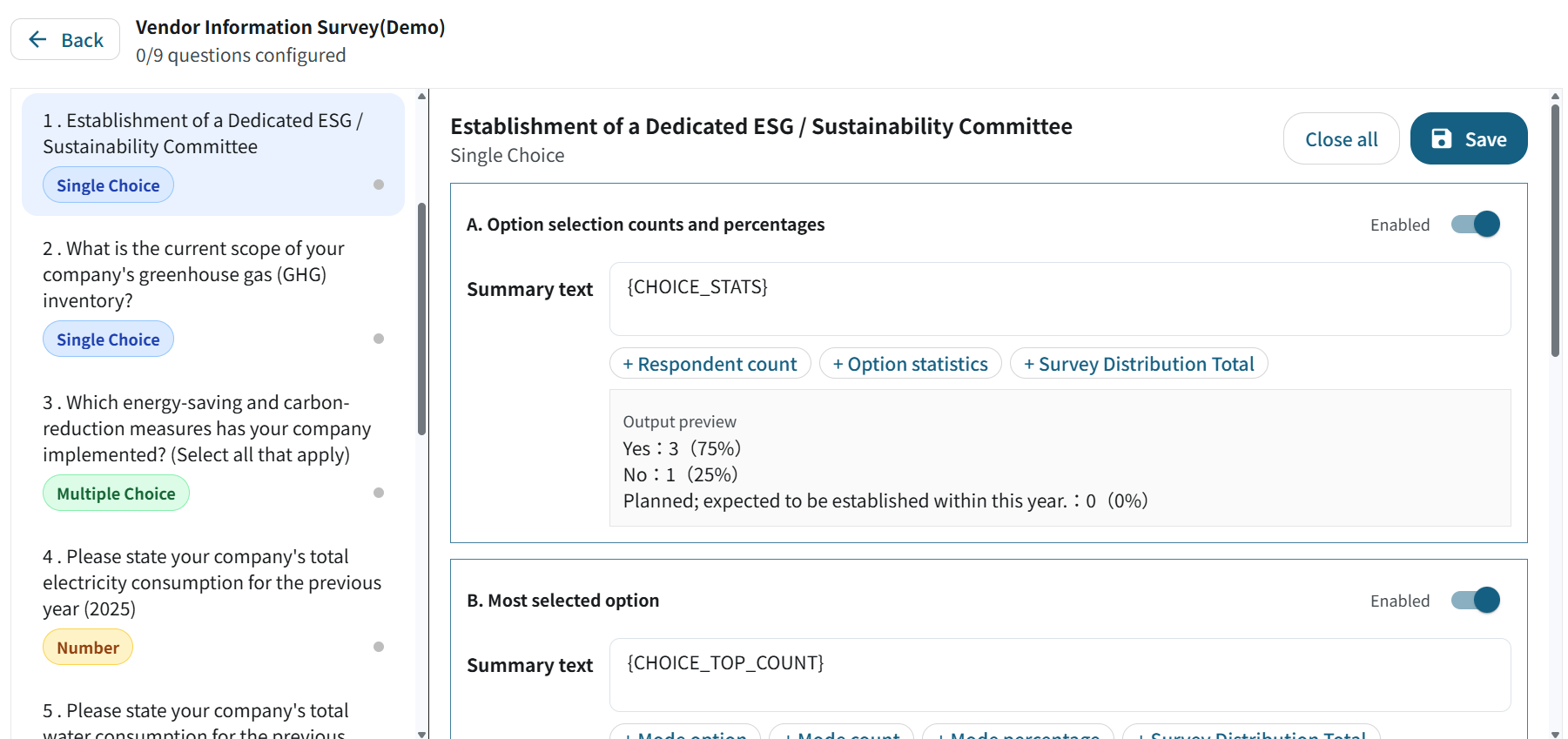
The statistical parameters and summary text of the questionnaire can be flexibly set, and the survey results can be directly brought into the sustainability report co-editing module to reduce repeated sorting and manual transcription.
Create a multi-layer approval template based on internal and supplier questionnaires, and flexibly specify groups, users and approval methods to ensure that the investigation results are reviewed according to the process.
The module centrally displays the release and response status according to the year, questionnaire and survey target. The organizer no longer has to track one by one through emails and forms, and can quickly find out the unfinished projects.
The team can set question types, answer conditions, attachments and scoring methods according to different survey situations, and reuse the existing structure to reduce the time of re-creating tables and formulas each time.
The answer content, supporting documents and review status can be directly matched in the same interface, allowing reviewers to quickly confirm the completeness of the data and reduce the time of missing gaps and repeatedly searching for attachments.
The system calculates questionnaire scores and risk levels based on set rules, helping teams quickly identify high-risk suppliers and issues that need improvement, and focus management resources on priority projects.
The approval level and reviewers can be set according to the type of questionnaire, and complete records of submission, return, modification and approval are kept, so that every processing level and opinion can be traced.
The survey results can be converted into visual charts and parametric text, and directly connected to the sustainability report co-editing module, reducing the work of duplicating statistics, charting and writing summaries.