
CMRT/EMRT Investigation and Risk Tracking
Centrally manage CMRT and EMRT investigation data of raw materials and suppliers, automatically present comparison results and risk levels, and quickly track due diligence and smelter information.
Faced with complex mineral sources, companies need traceable due diligence
Responsible mineral investigations involve numerous suppliers, raw materials, products, minerals and smelting plant information. Any missing piece of information may affect a company's ability to respond to customers and expose supply chain risks.
The responsible mineral management module centrally processes CMRT/EMRT questionnaires, smelter compliance comparisons, anomaly identification and risk tracking, allowing companies to trace supply sources from products or raw materials upwards, understand investigation progress and compliance status, and retain complete due diligence records.
The CMRT/EMRT questionnaire is scattered in emails and different versions of Excel. The organizer needs to confirm one by one whether there is a reply, whether the information is complete, and which suppliers still need to be tracked.
Suppliers use questionnaires from different years or versions. The content may be missing, the format may be modified, or the data may be filled in incorrectly. Manual consolidation may easily lead to duplication and misjudgment.
The same raw material may come from multiple suppliers or be used in multiple products; when customers ask about the source of minerals for a specific product, it is difficult to quickly trace the relevant supply chain.
The questionnaire contains a large amount of smelter and refinery information, and the names may be inconsistent or the information may be incomplete. Comparing the lists one by one is not only time-consuming, but also difficult to identify high-risk or abnormal items in a timely manner.
After completing the questionnaire collection, it is still necessary to manually calculate the completion rate, compliance rate, mineral types and smelting plant distribution, and then compile the results into a report for customers or management.
From supplier and raw material filing, questionnaire collection to risk identification and report output, the system completely connects the responsible mineral due diligence process, so that mineral sources, compliance determinations and tracking records are all based on evidence.
Supplier and raw material filing → Investigation scope setting → CMRT/EMRT questionnaire collection → Data analysis and verification → Smelter compliance comparison → Risk classification and tracking → Statistical analysis → Report output
Establish supplier, raw material and product information, and connect the supply chain relationship with the actual scope of use.
Define investigation objects by year, mineral type, supplier or product, and establish a due diligence list for the current period.
Centrally manage the questionnaires answered by suppliers, and clearly understand the source, version and last update time of the questionnaire.
Compile the contents of the questionnaire and check for gaps, formatting and filling abnormalities to reduce the time of manual column-by-column confirmation.
Identify and compare the smelter and refinery information in the questionnaire, and present the compliance results of each mineral type.
Mark the risk level based on the questionnaire content and comparison results, and target suppliers that are incomplete, non-compliant or require further confirmation.
Check the questionnaire completion rate, compliance rate, number of exceptions and annual changes through the dashboard to understand the overall investigation progress.
Compile company policies, investigation scope, supply chain results and compliance statistics, and produce a responsible minerals report.
Centrally manage CMRT and EMRT investigation data of raw materials and suppliers, automatically present comparison results and risk levels, and quickly track due diligence and smelter information.
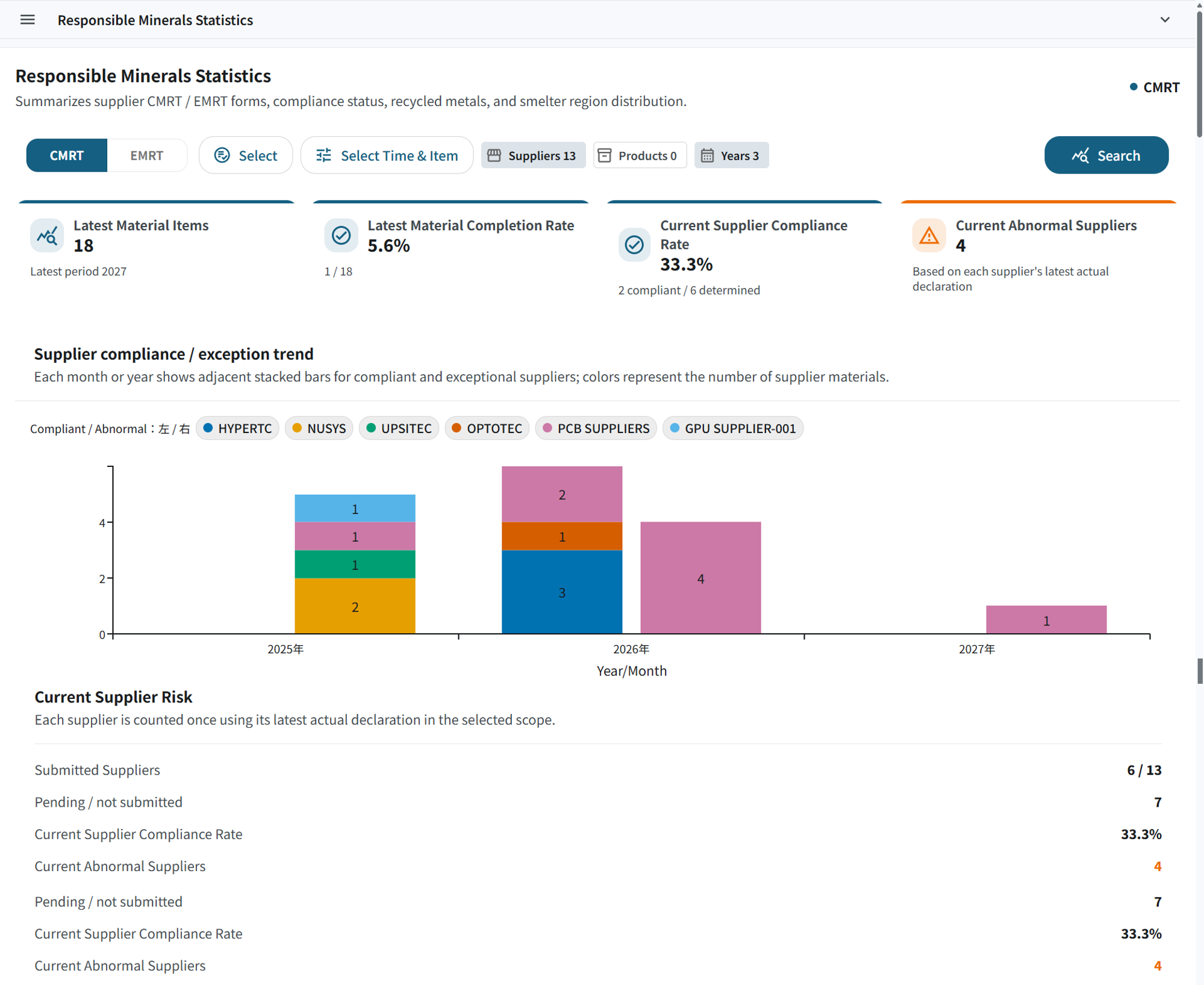
Use a visual dashboard to summarize CMRT/EMRT recycling progress, compliance rates and abnormal trends, and quickly grasp supply chain due diligence results and items to be tracked.
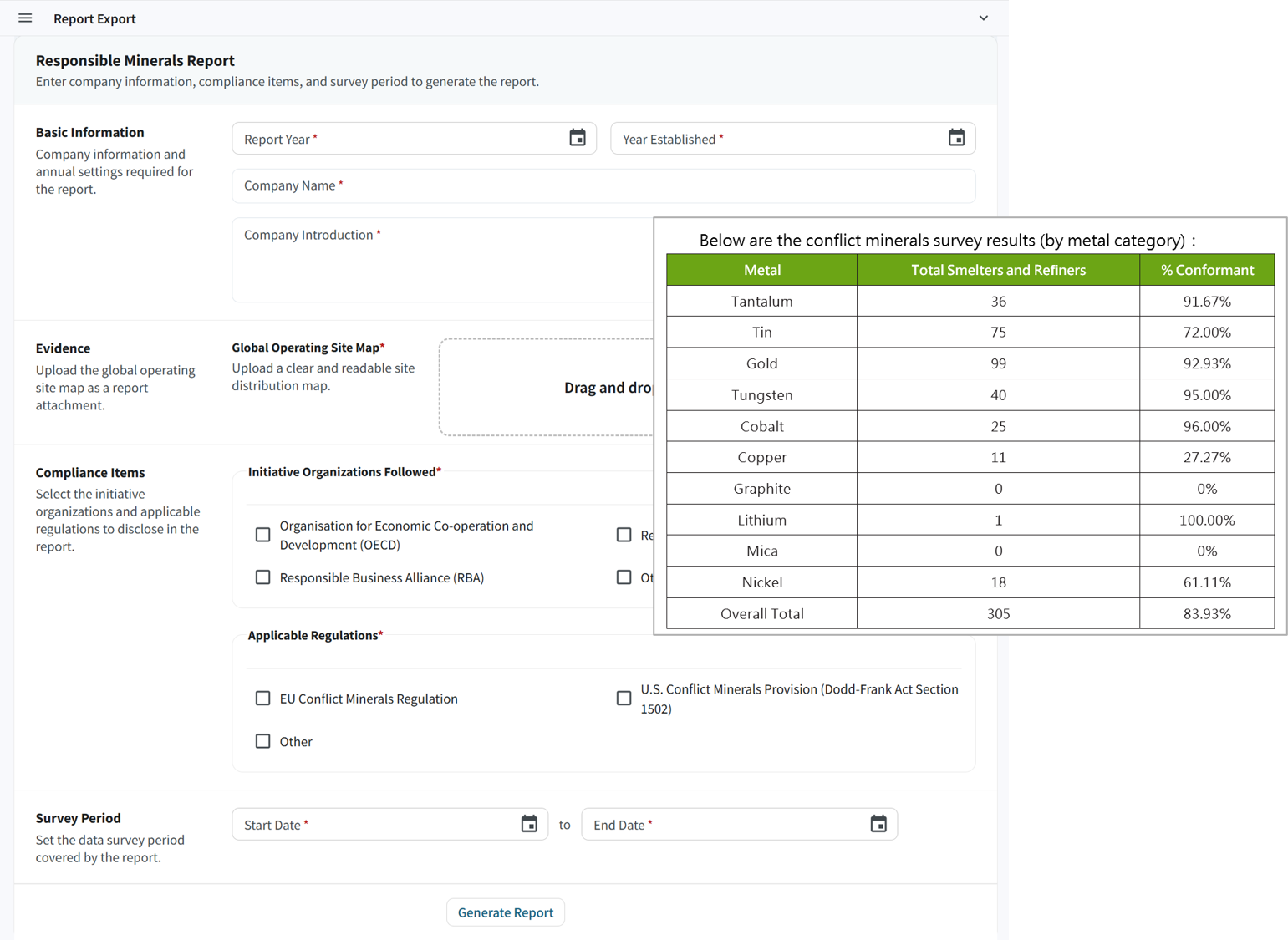
Integrate company information, supply chain investigation results and applicable standards to quickly produce responsible mineral reports, clearly revealing the compliance status of various mineral smelters.
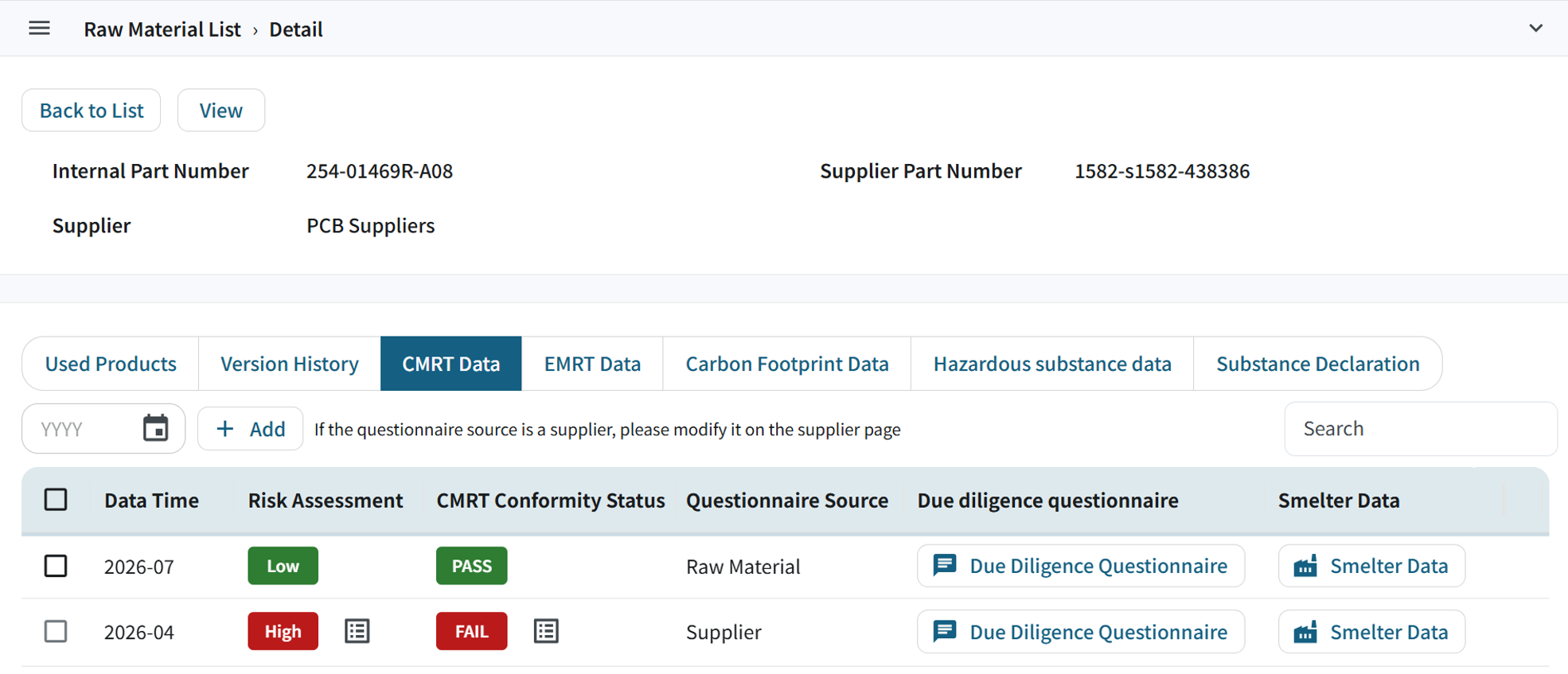
The module centrally displays the response status and attachments by year, supplier and form type. The organizer no longer has to sort through emails one by one and can quickly find uncompleted survey objects.
The system centrally displays the form data status and comparison results, allowing omissions, format errors and abnormal content to be identified early, and assisting the organizer in arranging the subsequent confirmation sequence.
Product, raw material, supplier, questionnaire and smelter data can be linked to each other, allowing teams to quickly trace the supply sources and investigation records involved from a specific product or raw material.
Smelter data can be centrally compared with the compliance list to clearly display compliance, abnormal and high-risk items, allowing tracking resources to focus on suppliers that really need to be dealt with.
Managers can instantly check the questionnaire completion rate, smelter compliance rate and abnormal trends without waiting for manual compilation at the end of the period, and can continue to understand changes in supply chain risks.
Survey statistics, compliance status of minerals involved and smelters can be directly summarized into report content, shortening the preparation time for responding to customer questionnaires and disclosing responsible mineral information.